
The It-Book Era: When Fashion Fell for Literature
A recent piece in The Business of Fashion asked why books have become fashion's favourite cultural accessory. It's a good question. Here is a slightly different one: what does it mean for literature when it becomes desirable?
Something has shifted. Books are no longer just books. They are objects of desire, carried, photographed, gifted, displayed. Fashion has noticed, and it has moved fast.
You can see it in the tote bags that cost more than a first edition. In Kaia Gerber posting her annotations online, building a book club where her followers actually read alongside her. In Dua Lipa recommending Mikhail Bulgakov to an audience of millions through her cultural newsletter Service95, and people actually buying The Master and Margarita because of it. In Bottega Veneta quietly supporting MAGMA, an independent art journal modelled on Bataille's Documents and the Surrealist Minotaure, without folding it into a campaign or putting their name on it. In Dior releasing a Very Hungry Caterpillar collection: a CHF 3,200 embroidered tote, a CHF 1’450 shirt, a CHF 170 porcelain tray.
Some of this is genuinely interesting. Some of it is a tote bag printed with a childhood picture book that costs considerably more than the complete works of Eric Carle. Both things are true at once, and the distance between them is where the most entertaining questions live.
But this relationship isn't new.
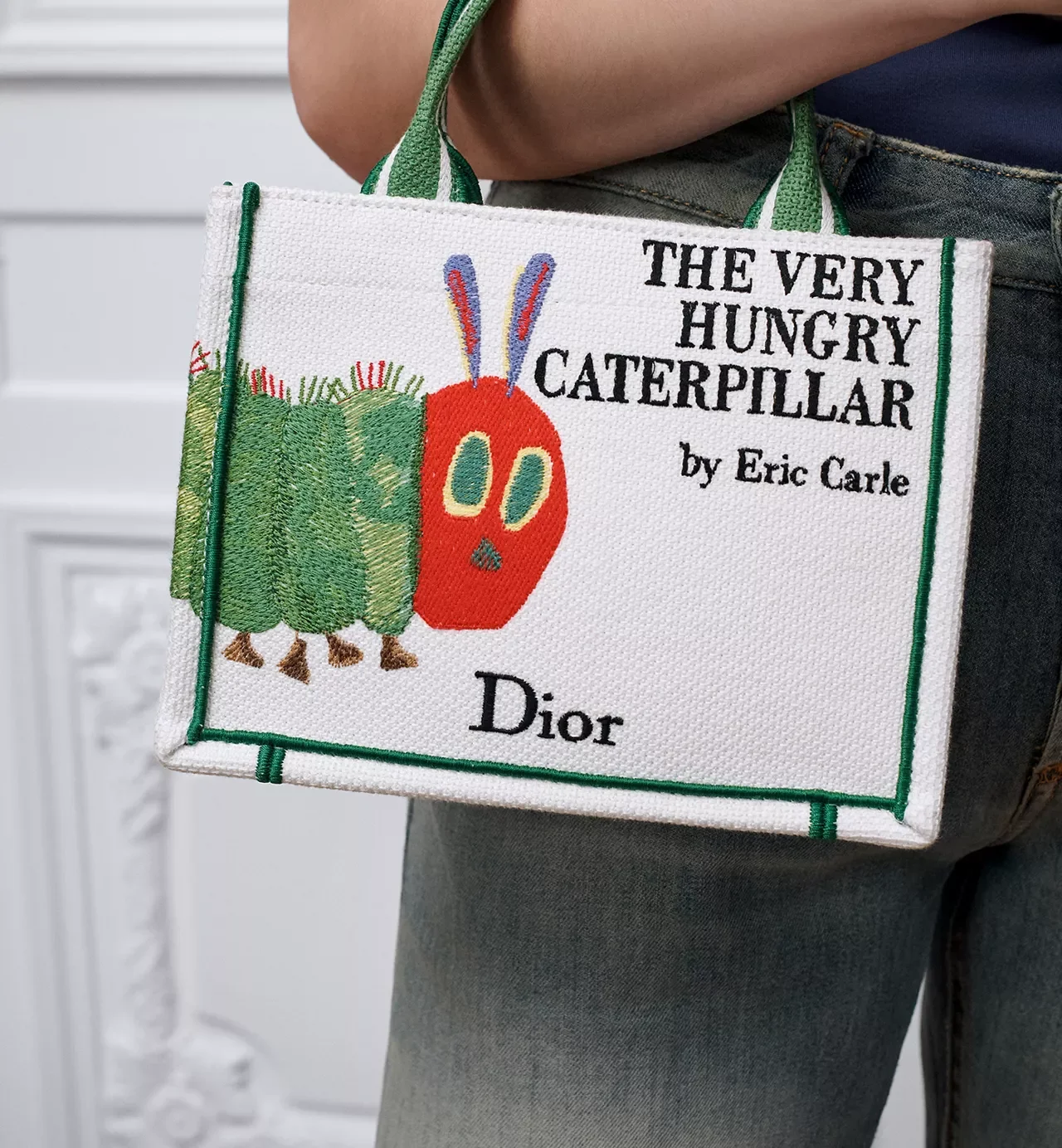
Image: Dior
It started in the studio
Fashion has always read. Alessandro Michele built his Gucci AW18 collection around Donna Haraway's A Cyborg Manifesto. Loewe's SS25 men's show borrowed its entire framework from Susan Sontag's Against Interpretation. Celine put Joan Didion — literary heavyweight, not decorative prop — in a campaign in 2015, and the image went viral in ways nobody predicted. Maria Grazia Chiuri's Dior shows have paid homage to Sylvia Plath. McQueen drew on Kubrick adaptations.
The relationship between fashion and literature isn't new. What's new is that it moved from the studio to the shop floor, from the designer's reference library to the consumer's handbag. And that shift is worth examining.
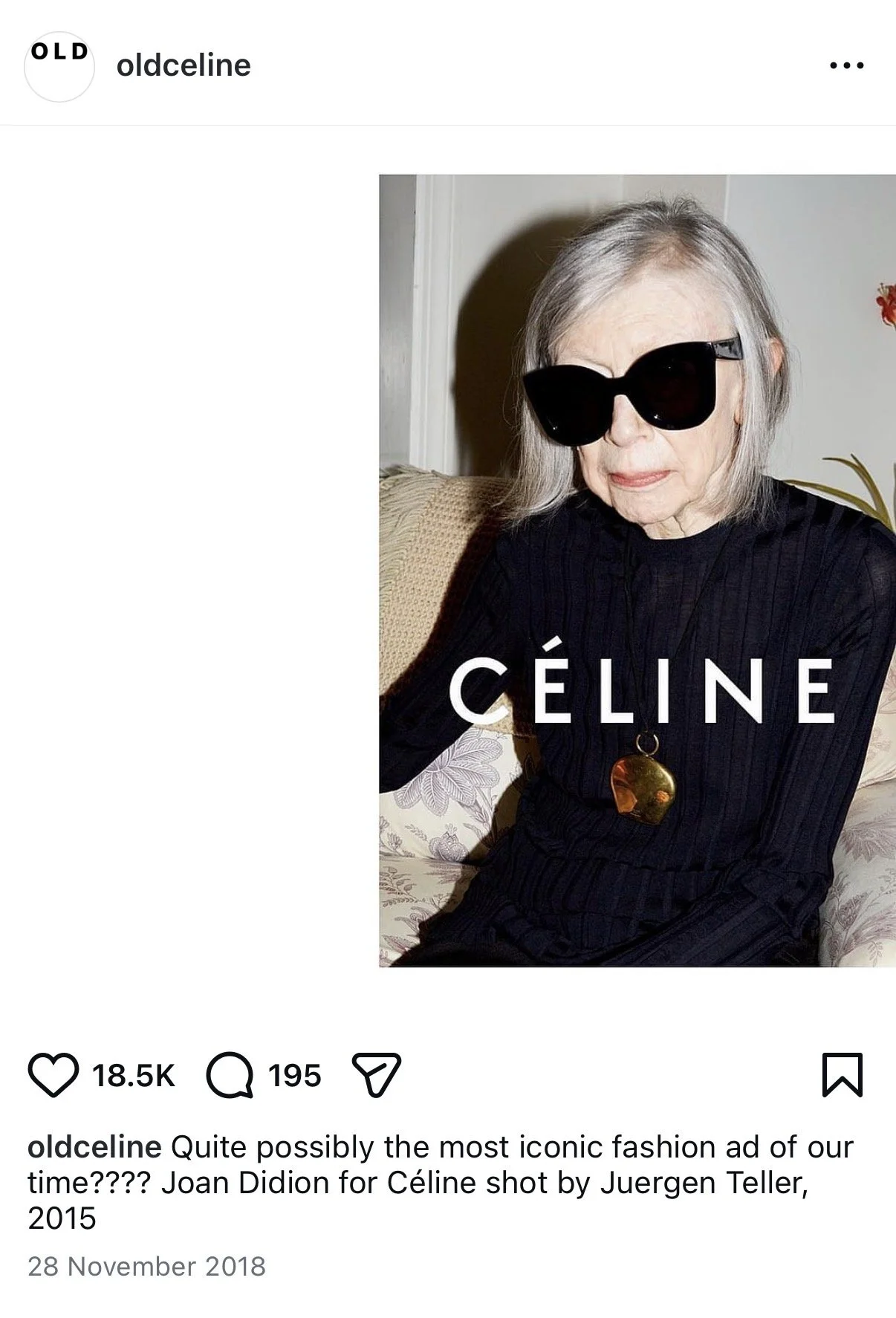
Image: @oldceline
When it works
Miuccia Prada didn't discover books recently. Her intellectual formation — feminist theory, political philosophy, contemporary art — has always been present in her work. When Miu Miu launched its Literary Club, it felt like an extension of something already there. Now in its fourth iteration, the 2026 edition — Politics of Desire — centred on Nobel Prize-winning Annie Ernaux and post-colonial feminist writer Ama Ata Aidoo. Three days of panels, lectures and readings in Milan. Real authors. Real arguments. The books weren't decorating the brand. The brand was, in some sense, already a book.
Chanel has been running its Literary Rendezvous for years — a travelling talk series built around women authors, past guests including Rachel Cusk and Rilke. In February 2024, Saint Laurent opened a bookshop in Paris curated by Anthony Vaccarello. A fashion house opening an actual bookshop is a more serious gesture than a tote bag. It means committing to a physical space, a curatorial position, an ongoing relationship with publishing.
Bottega Veneta's approach is quieter still. No announcement, no campaign — just funding for MAGMA, an independent art journal in the tradition of the great avant-garde revues d'art of the 20th century, with a preface by Hans Ulrich Obrist. They don't put their name on the cover. Three issues in. Growing.
Then there is the celebrity book club phenomenon, which deserves more credit than it gets. Kaia Gerber's Library Science started with annotated pages on Instagram — genuine, slightly chaotic evidence of someone actually reading. It now has a merchandise line, a physical publication, and 6,000 likes on a t-shirt that says HOT / CAN READ. Whether that evolution represents literary culture expanding or the aesthetic of reading absorbing what was once the real thing is a question worth sitting with.
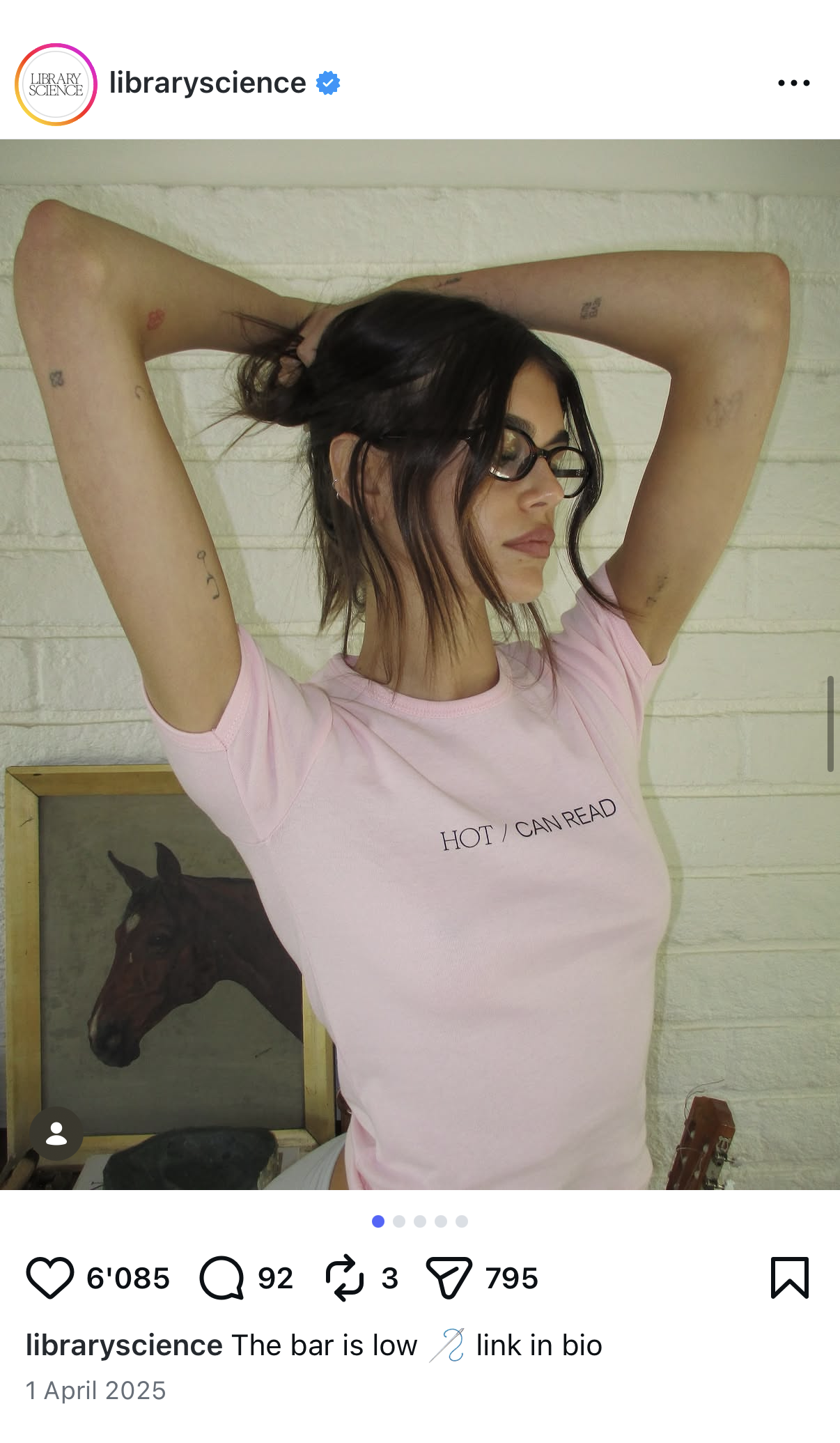
Image: @libraryscience
The flat lay problem
Here is where it gets complicated.
Somewhere between Miuccia Prada's intellectual biography and the Very Hungry Caterpillar tote, something happens to the book. It becomes a prop. Often a beautiful one — but a prop: an object that signals reading without requiring it.
The escalation is worth tracking. Tote bags and collection references come first, then rare books as luxury objects. Librairie 7L, Karl Lagerfeld's own bookshop, now offers a bespoke library curation service for CHF 9,300 a year plus a joining fee of CHF 4,500 . Books have become fashion grails in the same way a rare sneaker or vintage bag is a grail. The object matters. The contents are secondary.
Fashion is good at this because it is exceptionally good at making things desirable. A brand that photographs a book the way it photographs a shoe — as a beautiful object with something aspirational attached — is doing something different from a brand that asks its audience to read.
Book culture online has been doing the same thing for years. The perfectly lit stack. The spine turned outward. The book chosen because it photographs well. These images are often lovely. They are also, sometimes, a form of performance that has very little to do with what is inside.
A comment under the BoF piece put it plainly: "Either you're a reader or you're not. No tote bag changes that." Another asked, more carefully, to what extent fashion brands are actually promoting reading versus using books as props. A third observed that the real flex is no longer owning the book, it's the capacity to stay with a single thought inside a feed engineered to break it.
All three are right, in different ways. This conversation doesn't resolve neatly, which is probably why it's worth having.
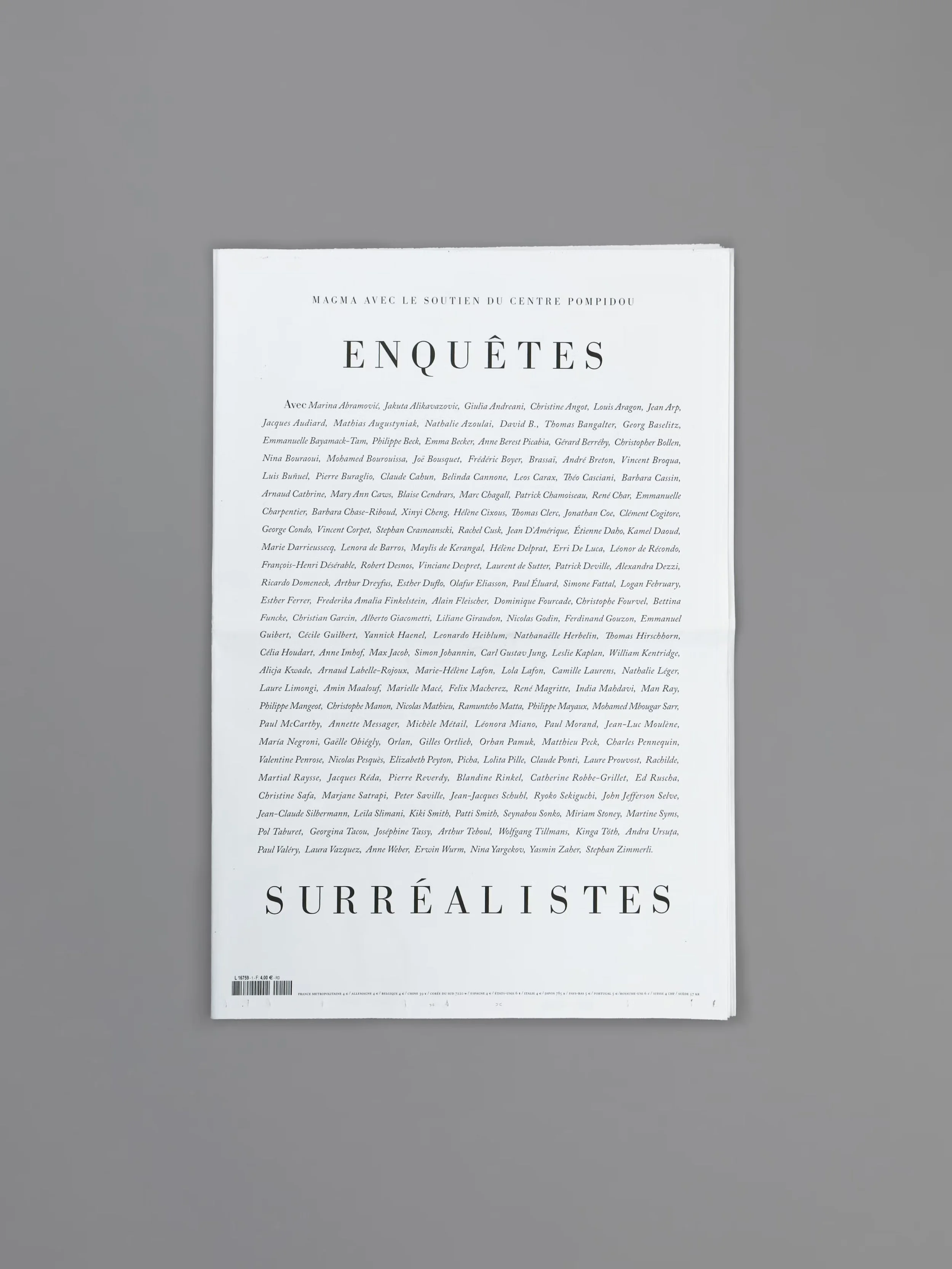
Image: Copyright MAGMA / DOCUMENTS All Rights Reserved
The Dior question
The Very Hungry Caterpillar collection is worth pausing on, because it might be the most honest example in the current landscape.
Nobody expects you to have read it recently. Nobody carries that tote to signal engagement with Eric Carle's ideas about metamorphosis. They carry it because it's joyful, visually graphic, and costs CHF 3,200. The book is a motif, not a reference.
There's something almost refreshing about that. Dior isn't pretending this is about literature. It's about the cultural memory of childhood, the pleasure of a recognisable image, the nostalgia economy. Compared to a tote printed with Dracula or Ulysses — books chosen to signal intellectual taste — the caterpillar is at least transparent about what it is.
Which raises the question: is using a children's picture book as a luxury motif better or worse than using Bulgakov?
No clean answer. But the question is more interesting than it first appears.
What literature actually needs
The appetite for books is real. A Pew Research report found Gen Z reads more than any previous American generation, with 70 per cent preferring print. A 2025 paper in the International Journal of Research in English argues that fashion and literature function as parallel semiotic systems, both encode meaning, both reflect social values, both shape and are shaped by the cultures they emerge from. The relationship, the paper suggests, has always been two-directional.
That framing is useful. It moves the conversation away from fashion exploiting literature, or literature lending credibility to fashion, and toward something more nuanced: two systems that have always been in dialogue, now doing so in a particularly visible and commercially legible way.
For those of us who work with books professionally — selling rights, building the international life of a title, finding the right publisher in the right language — this cultural moment is worth watching carefully.
The attention is welcome. When fashion points at a book, people look. When a celebrity with a genuine reading practice recommends something unexpected, sales move. When a brand builds an event series around literature and puts readers in a room with writers, some of those people discover something they didn’t know they were looking for.
But literary culture does not run on desirability alone. It runs on readers — people who open the book, stay with it past the first difficult chapter, finish it, and go looking for the next one. The aesthetic of reading and the practice of reading can coexist, and often do. The best version of fashion’s literary moment knows this. It says: we find books beautiful and we find what’s inside them worth thinking about, and we want both to be true at once.
That is a reasonable position. In the best cases — Miu Miu, MAGMA, Kaia Gerber’s annotations — it is exactly what is happening.
The it-book era has arrived. Literature is in fashion. As someone who has spent years arguing that books deserve more attention, more visibility, more international reach — I am not complaining.
I am just keeping an eye on whether anyone is actually reading them.
Inspired by How Books Became Fashion’s Favourite Flex — Business of Fashion.
Further reading:
On the Same Page - Vogue Australia
Threading the Page: Connecting Literature and Fashion — International Journal of Research in English (2025)